

How Long Does The Imune Syatem Take To Remove A Tattoo
Tats Off: Targeting the Allowed System May Atomic number 82 to Improve Tattoo Removal
A discovery about the body's cellular waste system could assist usa erase unwanted ink
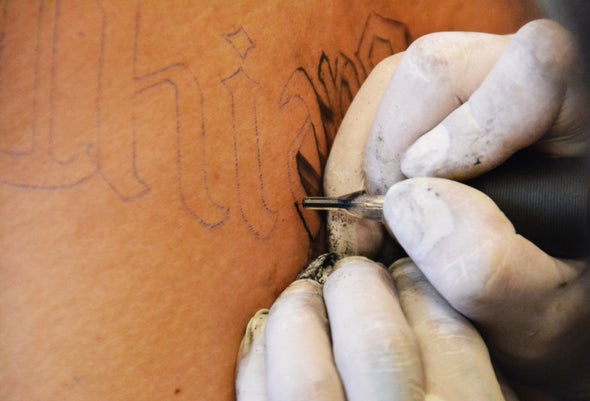
People who are thinking about getting inked are frequently told, "a tattoo is for life." Etched into the layer of skin just below the epidermis, they are notoriously difficult to remove. And the laser surgery method for doing so is costly, fourth dimension-consuming and—frequently—has far from perfect results.
A new discovery published Tuesday in The Journal of Experimental Medicine may eventually change the situation: It fleshes out the cellular processes that make tattoo ink so persistent, and offers a new strategy for potentially removing it more effectively. A French enquiry team establish that blocking the immune organization's own macrophages—cells that identify and engulf cellular debris, microbes and other foreign bodies—would probable aid erase tattoos' permanence.
Immunologist Sandrine Henri of The French National Institute of Health and Medical Research, the National Center for Scientific Enquiry, and Aix Marseille Academy, and her colleagues research the origins and genetics of peel macrophages in guild to understand how they interact with other allowed cells in the peel. Tattoos have non been a focus of their piece of work, just their new study suggests they may take stumbled on a discovery that could alter the futurity of ink removal: They constitute mice with blackness coats appear to have a specific type of skin macrophage that ingests pigment particles when the cells that unremarkably shop the particles dice off. Follow-upwards experiments, described in the new newspaper, suggest macrophages may also play a role in absorbing particles of tattoo ink.
First the team worked to prove macrophages take up tattoo paint. They genetically engineered a strain of mice to have pare macrophages with diphtheria toxin receptors; this gave the researchers the ability to selectively impale off those cells by injecting the mice with the toxin. Side by side they tattooed the animals' tails with dark-green fluorescent ink and examined sections of the tattooed skin under a microscope to confirm the ink particles are indeed taken upwards by the macrophages. So the researchers exposed the animals to the diphtheria to impale off these cellular trash collectors.
Although the macrophages died as expected, the researchers were surprised to run into the ink persisted for many months—even later on all the macrophages that had taken up the ink particles had been replaced. In another ready of experiments the tattooed tail skin was grafted onto the backs of albino mice. Again, the researchers found that vi weeks later, although the cells in the graft had all died, the ink remained.
And then how is that possible? The piece of work suggests tattoos endure because their pigment is consumed past one macrophage after another: When i dies, it simply releases the ink particles information technology had been storing. Then another macrophage comes along, clears away the cellular droppings and engulfs the particles.
"The fact that macrophages hardly move within the skin explains why the tattoo is pretty stable," Henri says. "Moreover, the pigment particles nowadays in tattoo ink are quite big—and attributable to their size they aren't drained into the lymph nodes via the lymphatic vessels. So as presently as they are released by dying macrophages, they remain stuck until another macrophage ingests them."
Simon Yona, an immunologist at University College London who studies macrophages and was not involved in the new work, praised the way the researchers engineered their experimental animals. "We were actually in the dark well-nigh how tattoo pigments stay inside the peel for such long periods of fourth dimension," he says. "But this beautiful written report identifies the cells that take upwardly tattoo ink. It's an exciting advance that has the potential to be developed farther," he adds. "It really does provide a strategy to remove unwanted tattoos, in combination with conventional approaches, which could be particularly useful for removing pocket-size tattoos in a well-defined location."
Henri says she and her colleagues are already on their way to developing a method for delivering genetic instructions to specified types of immune cells, and they plan to work closely with dermatologists on the next stages of their piece of work. She hopes light amplification by stimulated emission of radiation tattoo removal could work better if performed in combination with the temporary inhibition of skin macrophage function. With this approach, she says, "the pigment particle fragments generated past the laser pulses would not be immediately recaptured by macrophages—increasing the likelihood that they will drain abroad via the lymphatic vessels."
Every bit with most therapies, however, at that place may exist risks. Although feasible in principle, this culling approach would demand rigorous safety testing—because blocking macrophage role has been shown to inhibit wound healing, and besides tin can impair the regeneration of skeletal muscle.

How Long Does The Imune Syatem Take To Remove A Tattoo,
Source: https://www.scientificamerican.com/article/tats-off-targeting-the-immune-system-may-lead-to-better-tattoo-removal/
Posted by: millshatesel.blogspot.com
0 Response to "How Long Does The Imune Syatem Take To Remove A Tattoo"
Post a Comment